If humans were rational actors, good user experience would be simpler to achieve: the most efficient path from A to B would always result in the highest satisfaction ratings.
Humans, however, are far from rational. This is particularly pronounced when engaged in a mode of exploration, with no specific goal in mind other than keeping themselves engaged. It is a growing trend in digital, epitomised by services like Twitter and Pinterest, which have the potential to pull users into a vortex of almost never-ending exploration.
A healthier approach, perhaps, would be to recognise this mode of exploration is not motivated by a tangible outcome or occupying a defined time period, but rather satisfying emotional needs. Those needs may vary from escapism to self-improvement. As such, they are particularly difficult to uncover through user research. A focus on observational insight and what isn’t being said is especially important in these scenarios.
It should also be remembered that while user journeys during modes of exploration often follow winding and illogical paths, they can be enhanced and supported by the presence of a meta layer which serves to provide structure, bookmarking and way-finding.
For further research, try these #mexsession talks:
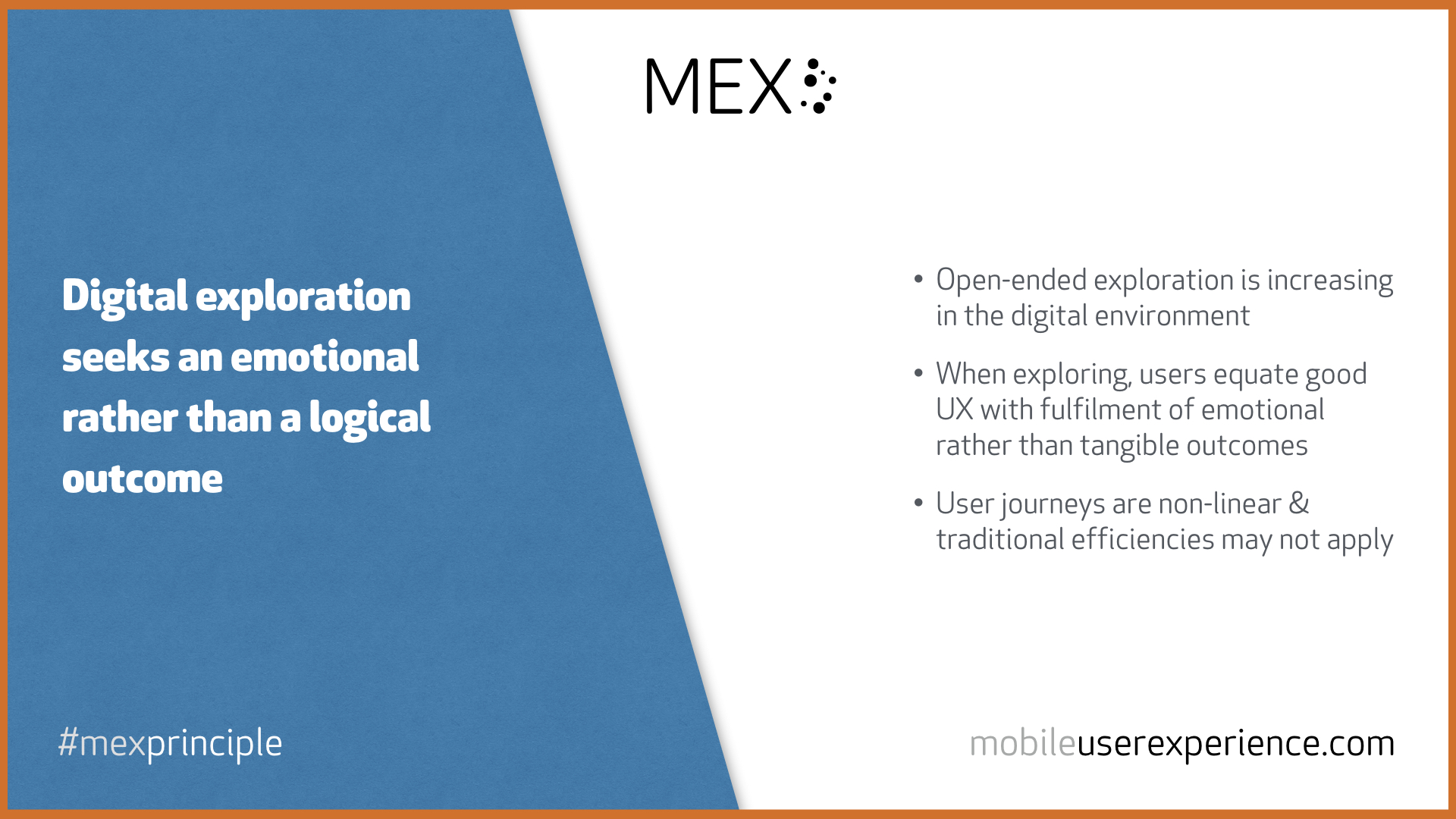
The principle, part of an emerging series in the MEX journal, is summarised below in a tweetable, shareable graphic. Thank you for citing appropriately.
Mirren Fischer is someone who finds herself at the confluence of some really big challenges:…
Poetry and place...listening and lockdowns... Dan Phillips, who led the Royal College of Art's (RCA)…
Mark Baldino's path to co-founding a Chicago-based design agency wends its way from a degree…
Paul Campbell, a former chief designer at Ford, is now re-imagining the wheelchair at Centaur…
Opening the oven released a cloud of steam. I should have been expecting it. It's…
Jared Ficklin's approach of 'think by making' has led him to produce remarkable digital design…